 Website


generative engine optimization
Generative Engine Optimization: 40% More AI Citations for Marketers
A practical GEO playbook for digital marketers: make claims extractable, add cited statistics and schema, and run 20–50 query tests to track AI citations.
Generative engine optimization (GEO) is the practice of structuring and evidencing your content, brand signals, and product data so AI answer engines can extract, cite, and recommend it. The business payoff is direct: pages built for extraction earn more citations inside ChatGPT, Perplexity, and Google’s AI features, which drives referral traffic even when the click never happens. Start this week by auditing whether your top pages contain quotable statistics, clear claims, and structured data an AI model can lift without guesswork.
TL;DR:
- Improving citation coverage involves adding specific, attributable statistics, quotes, and authoritative sources to underperforming pages, especially those with dense paragraphs.
- Technical optimizations that remain essential include ensuring crawlability, schema markup, and third-party mentions, which underpin content extractability and credibility in AI answers.
- Measuring GEO success requires tracking citation recall, accuracy, prominence, and share across multiple AI engines, not just traditional pageview metrics.
- Small teams can implement GEO by focusing on rewriting high-value pages, repairing structured data, and building external mentions, without needing a dedicated department.
- Using tools like dynamic structured data management platforms can significantly streamline updates and improve content’s machine-readability for AI citations.
Table of Contents
- What Is Generative Engine Optimization and How Does It Work?
- SEO vs. GEO: What to Keep and What to Add
- Why GEO Matters: Decision Support and Agentic Commerce
- Core GEO Strategies: Readability, Brand Context, and Machine-Readable Data
- How to Perform GEO: A Prioritized Checklist for Content Teams
- How to Measure GEO Performance
- What We See in Client Projects
- Challenges and Limitations of Generative Engine Optimization
- Future Trends and Evolving Practices in GEO
- Case Studies: How GEO Tactics Play Out in Practice
- Ethical Considerations and Risks Associated With GEO
- Publisher Perspective: Three Priorities for the Next 90 Days
- Turning Structured Data Into a Repeatable GEO Workflow
- Sources
- FAQ
What Is Generative Engine Optimization and How Does It Work?
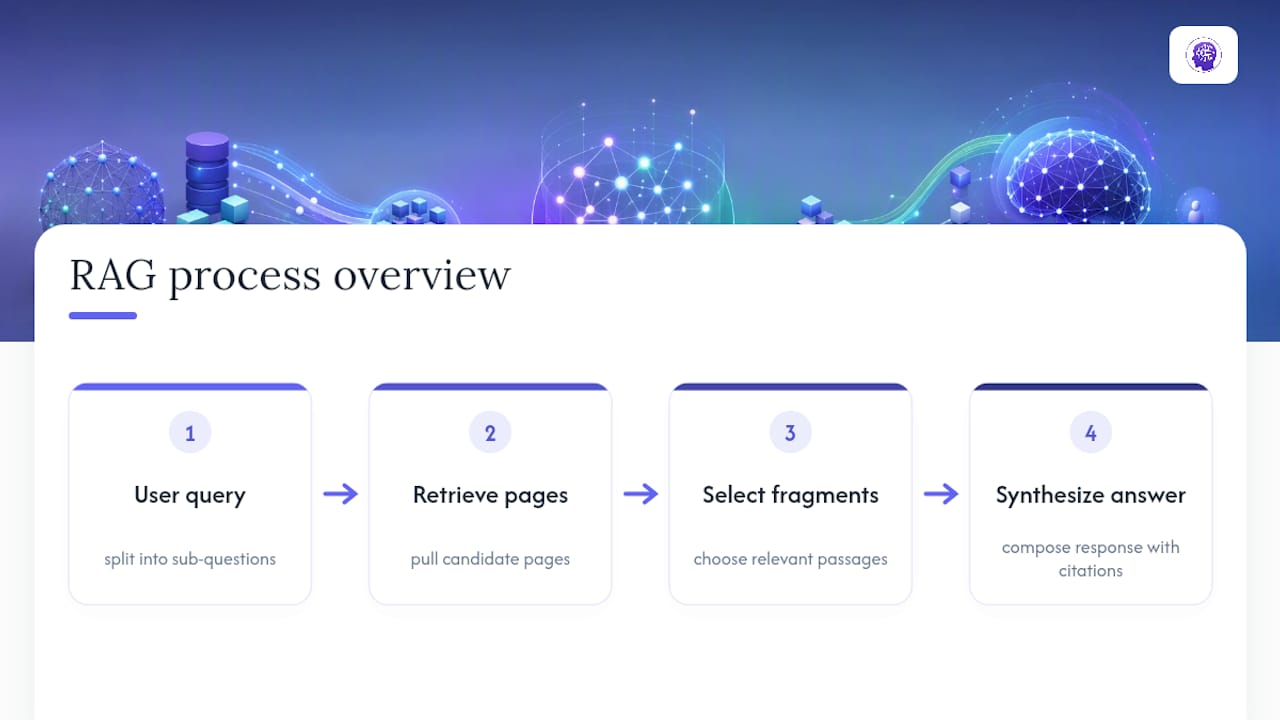
Traditional search engines retrieve and rank documents. Generative engines do something different: they retrieve a batch of sources, then synthesize an answer from them, deciding in real time which sentences deserve a citation. That process usually runs on retrieval-augmented generation, or RAG, where the model pulls a set of candidate pages, breaks a single query into several sub-questions (often called query fan-out), and pieces together a response from whichever fragments answer each sub-question best.
This shifts the unit of optimization. Ranking first on a search results page used to be the finish line. Now the finish line is getting a specific claim, statistic, or sentence pulled into a synthesized answer and attributed to your brand. A page can rank well in classic search and still get skipped entirely by an AI answer if its content is not written in a form the model can lift cleanly.
That gap between “ranks well” and “gets cited” is worth naming directly: call it the citation gap. Many pages that dominate organic search never appear in AI-generated answers because their best information is buried in dense paragraphs, vague claims, or unlabeled numbers. Closing that gap is the entire discipline of GEO for AI websites.
SEO vs. GEO: What to Keep and What to Add
Search engine optimization techniques are not obsolete. Crawlability, site speed, clean information architecture, and topical depth still determine whether an AI engine can access your content at all. Google’s own guidance on optimizing your website for generative AI features confirms that foundational SEO remains a prerequisite, not a legacy task to abandon.
What GEO adds sits on top of that foundation: extractability (can a single paragraph stand alone as an answer), corroboration (do other credible sites say the same thing), and third-party mentions (does your brand show up in sources the model already trusts). None of these show up in a classic technical SEO audit.
For a practical roadmap, keep your existing crawl, schema, and content-quality work as-is. Add a second track focused on rewriting key claims into extractable form and building citations from outside sources. Treat GEO as a layer on automated SEO strategies, not a replacement for them.
Why GEO Matters: Decision Support and Agentic Commerce
AI answer engines do not present ten blue links. They narrow the field to a short, justified list, and whichever brands make that list get the attention. That narrowing carries real bias: these engines lean on third-party, independently published sources when synthesizing an answer, favoring earned coverage over brand-authored claims, according to research on generative engine optimization. A glowing product description on your own site carries less weight than the same claim appearing in a review, comparison article, or industry roundup.
The stakes rise further with agentic commerce, where AI agents browse, compare, and even purchase on a shopper’s behalf. Those agents depend on machine-readable product data, meaning price, availability, and identifiers formatted so software can parse them without a human reading the page. A product with rich, accurate structured data is legible to an agent. A product described only in marketing prose is invisible to one, regardless of how persuasive that prose reads to a person.
Core GEO Strategies: Readability, Brand Context, and Machine-Readable Data
GEO strategy breaks into three connected pillars, as outlined in industry analysis of the core GEO pillars: LLM readability, brand context, and agentic commerce. Technical SEO underpins all three but cannot substitute for any of them.
LLM readability means writing so a model can extract a clean answer without stitching fragments together:
- Structure paragraphs as self-contained “nuggets” that answer one question in three to five sentences, evidence included.
- Use descriptive headings that mirror real questions, since models weight heading text heavily when matching a query to a passage.
- Break comparisons and steps into lists rather than burying them in a paragraph.
- Label statistics explicitly (“39% of respondents…”) instead of vague phrasing like “many people.”
- Add direct quotations and named sources, since controlled testing found that citing credible external sources produced the largest single lift for under-ranked pages, improving visibility by up to 40% in experimental settings.
Brand context covers how your brand appears outside your own domain. Pursue mentions in trade publications, comparison sites, and forums where your category gets discussed. Keep your brand description consistent across your site, social profiles, and directory listings, since AI models cross-reference co-occurring facts to judge reliability.
Agentic commerce requires machine-readable offers, meaning price, stock status, GTIN, and review counts published in a consistent feed across your site and any marketplaces you sell through, per the same GEO pillars research.
Technical signals still matter: implement JSON-LD schema for products, articles, and FAQs, and confirm AI crawlers have permission in your robots configuration. On the llms.txt debate, Google states plainly that special files like llms.txt are unnecessary for Google Search, though some practitioners still add them for other engines or custom agent stacks. Treat it as optional, not foundational.
How to Perform GEO: A Prioritized Checklist for Content Teams
Most teams already run SEO sprints. GEO work fits into that same cadence if you sequence it correctly instead of trying to fix everything at once.
- Audit crawlability first. Confirm AI crawlers (GPTBot, PerplexityBot, ClaudeBot) are not blocked, and check that your most important pages render without JavaScript dependency issues.
- Add extractable claims and statistics to your highest-traffic pages, rewriting dense paragraphs into short, evidence-first passages a model can quote directly.
- Add authoritative external citations and direct quotes, since this single change produced the strongest documented lift in controlled GEO testing.
- Add or repair structured data for products, articles, and organizational facts, prioritizing pages tied to revenue.
- Widen earned media distribution by pitching data points and quotes to trade press, since third-party placement compounds citation odds faster than incremental on-page tweaks alone.
Smaller teams do not need a dedicated GEO department to start. One content lead can own the extractability rewrites, one technical owner can handle schema and crawl permissions, and both can review results monthly rather than daily, since AI answers shift more slowly than search rankings.
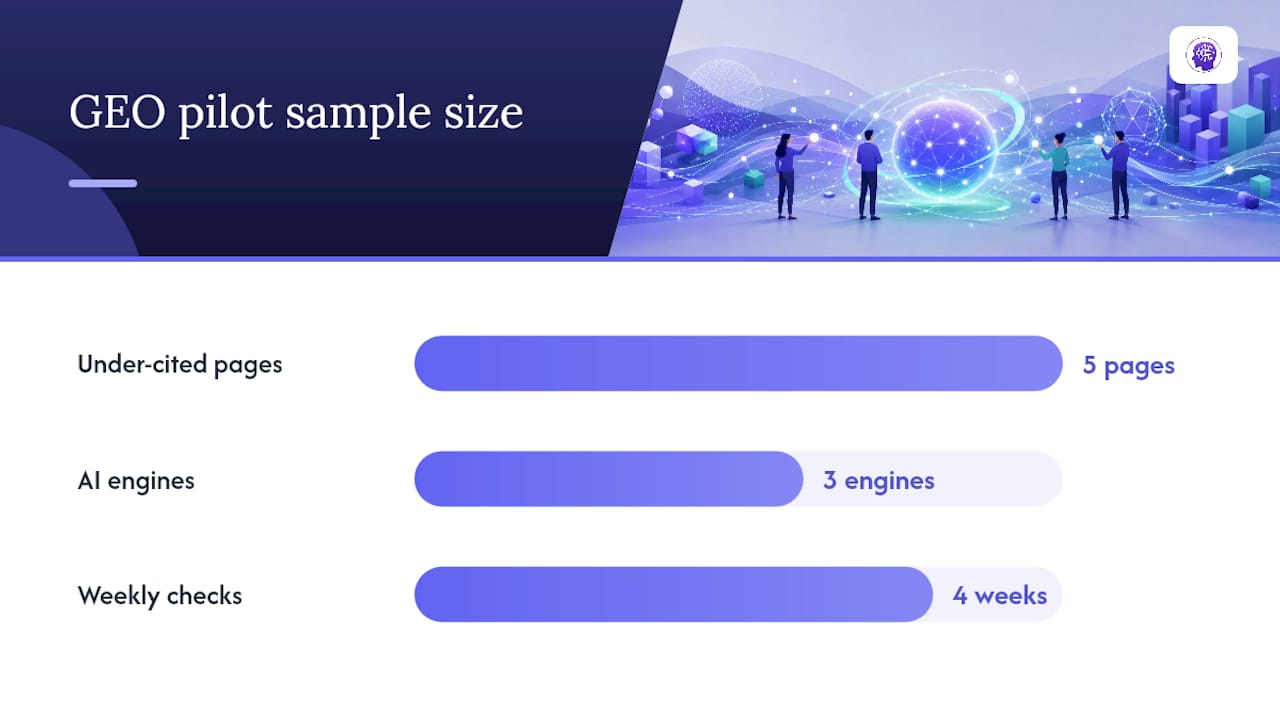
Pro Tip: Pick five under-cited but high-value pages, add statistics, quotes, and external citations to each, then query the same five questions across three AI engines weekly for a month. That small sample tells you within weeks whether your changes move the needle, without waiting for a full-site rollout.
This mirrors the iterative testing approach researchers used when validating GEO lift: change a handful of pages, sample repeatedly, and let the pattern emerge before scaling.
How to Measure GEO Performance
Pageview analytics miss most GEO impact because a citation inside an AI answer often satisfies the user without a click. You need citation-specific metrics instead, sampled directly from AI outputs, a point Google’s own generative AI guidance and independent GEO research both reinforce.
Four metrics matter most:
- Citation recall: the share of relevant queries where your brand appears anywhere in the AI answer.
- Citation precision: how often your cited claim is accurate and properly attributed, not paraphrased into something misleading.
- Impression score: a weighted count of how prominently and how often your brand surfaces across sampled queries.
- Citation share: your citation count relative to competitors on the same query set, the closest GEO analog to share of voice.
Build a query list of 20 to 50 questions your buyers actually ask, then run them against ChatGPT, Perplexity, and Google’s AI features weekly or biweekly, logging which brands get cited and how. Open-source tooling like the geo-optimizer skill can automate parts of this audit, checking bot access, schema richness, and content citability in one pass. Pair citation tracking with conversion testing on the pages you optimize, so you can tell whether increased AI visibility actually moves signups or sales.
What We See in Client Projects
Across customer projects, the same three gaps show up repeatedly: missing structured product data, claims written too vaguely to quote, and product feeds that break the moment a price or stock level changes. Each one quietly blocks AI citation, even on pages that already rank well in classic search.
WebsitePublisher.ai’s dynamic data model exists to close that last gap specifically. Because content lives as reusable, structured components rather than static text blocks, a price or availability change updates everywhere at once instead of requiring a manual edit on every page. Combined with support for over 104 built-in integrations and a visual editor that lets marketing teams adjust copy without redeploying code, the platform removes much of the manual overhead that normally delays structured-data fixes.
Challenges and Limitations of Generative Engine Optimization
GEO is harder to control than classic SEO because you cannot see the model’s reasoning or guarantee a citation the way you can chase a ranking position. Answer engines change their synthesis behavior with model updates, sometimes without notice, so a citation pattern that held for months can shift after a single model release.
Measurement remains the biggest practical obstacle. Sampling AI answers manually across multiple engines takes real staff time, and no single dashboard yet aggregates citation data the way Google Search Console aggregates rankings. Smaller teams often lack the bandwidth to sample consistently enough to detect real trends versus noise.
There is also an attribution problem specific to this format. An AI engine can summarize your idea accurately without naming your brand at all, which means you influenced the answer but get none of the visibility credit. That happens more often than most marketers expect, and it is nearly impossible to detect without deliberate, repeated sampling of the exact answers your buyers see.
Finally, GEO tactics that work on one engine do not always transfer to another. A page optimized heavily for ChatGPT’s citation behavior may perform differently in Perplexity or Google’s AI features, since each system weighs recency, domain authority, and structured data differently. Treat cross-engine testing as mandatory, not optional, before declaring any tactic a reliable win.
Future Trends and Evolving Practices in GEO
Expect agentic commerce to expand well beyond product shopping. AI agents booking appointments, comparing service providers, and filling out forms on a user’s behalf will make machine-readable business data (hours, pricing, availability, service areas) as important as product feeds are today. Businesses that treat this as a future problem will find themselves retrofitting structured data under pressure instead of ahead of demand.
Brand context optimization will likely become more formalized as a discipline of its own, closer to digital PR than to traditional link building. Since AI models weigh third-party corroboration heavily, expect more agencies and in-house teams to build dedicated programs for securing mentions in trade press, comparison roundups, and independent review sites, rather than treating earned coverage as a side effect of general marketing.
Measurement tooling should mature fastest of all, since it is the most obvious current gap. Expect more platforms, including open-source options like the geo-optimizer approach already available on GitHub, to package citation tracking, schema auditing, and crawl-permission checks into single dashboards rather than requiring marketers to query engines manually.
The llms.txt debate will likely stay unsettled for a while. Google has already stated the file is unnecessary for its own search features, but adoption may still grow among smaller AI engines and custom agent frameworks that lack Google’s crawling infrastructure. Watching which engines actually respect the file, rather than which blog posts recommend it, will separate genuine signal from speculation.
Case Studies: How GEO Tactics Play Out in Practice
The clearest documented example of GEO’s effect comes from controlled testing rather than anecdote. Researchers tested a set of specific interventions, adding cited statistics, direct quotations, and authoritative external references to under-performing pages, and measured resulting visibility inside generated AI answers. The strongest single intervention, citing credible external sources, improved visibility by up to 40% for pages that had previously ranked poorly in synthesized answers, according to the GEO research published on arXiv.
That finding matters more than a single number suggests, because it isolates the exact mechanism marketers can replicate. Pages did not improve because they got longer or kept more keywords. They improved because they gave the model something concrete and attributable to lift: a named source, a specific figure, a direct quote it could reproduce without paraphrasing risk.
The pattern holds a broader lesson for content teams: under-ranked pages have the most room to benefit from GEO fixes, since they have the furthest to climb and the clearest baseline to measure against. A page already performing well in classic search may show a smaller relative citation lift simply because it had less room to improve. Teams running their own tests should pick candidate pages with the same logic: choose pages that matter to revenue but currently underperform in AI citation, not pages that already dominate.
Ethical Considerations and Risks Associated With GEO
GEO introduces a temptation that did not exist in the same form under classic SEO: since AI models reward confident, well-cited claims, there is pressure to overstate certainty or manufacture authority signals that do not hold up. Adding a statistic because it sounds citable, without verifying its source, risks getting your own brand associated with a claim that later proves false. That damages trust with readers and, eventually, with the AI systems that learn to deprioritize sources with a pattern of inaccuracy.
Brand context tactics carry a similar risk if pushed too far. Legitimate earned coverage in trade press differs meaningfully from paid placements dressed up as independent mentions, and AI models are not currently equipped to reliably distinguish the two. Marketers who lean on disclosed sponsored content while implying independent corroboration are working against the same trust mechanics that make GEO effective in the first place.
There is also a fairness dimension worth naming. Smaller publishers and independent voices often lack the resources to run systematic GEO programs, which could concentrate AI citations further among already-dominant brands. Marketers building GEO programs should treat accuracy and disclosure as non-optional constraints, not friction to route around, since the same citation mechanics that reward good sourcing will eventually penalize brands that game them.
Publisher Perspective: Three Priorities for the Next 90 Days
Most teams should not try to run a full GEO program on day one. Pick three moves and execute them well: run a crawl and structured-data audit, rewrite ten to twenty high-value pages with labeled statistics and direct quotes, and publish or repair machine-readable product and service data. Those three actions cover the pillars that research consistently shows matter most.
Deprioritize speculative tactics like llms.txt unless you have specific evidence an AI engine you care about respects it. Fold GEO tasks into existing SEO sprints rather than spinning up a parallel process. Content teams already reviewing pages for search performance can add an extractability check to that same review cycle at almost no extra cost.
The teams that win here will not be the ones doing the most. They will be the ones doing the fewest things well, repeatedly, and measuring honestly.
Turning Structured Data Into a Repeatable GEO Workflow
Most of the GEO checklist above depends on one thing: getting structured data and updated content live without a development bottleneck. That is precisely where WebsitePublisher.ai changes the math for marketing teams building or maintaining sites on their own.
Describe your product catalog, service pages, or FAQ content in plain language, and WebsitePublisher.ai’s dynamic data model turns it into structured, reusable components rather than static text you have to hand-edit page by page. That structure is what feeds machine-readable offers, consistent pricing, and the kind of clean schema this article recommends for agentic commerce. Because the platform supports over 104 built-in integrations and works across ChatGPT, Claude, and other AI platforms, your team keeps working in whichever tool fits the task without losing the underlying project. When a price or product detail changes, it updates everywhere that component appears, closing exactly the kind of feed-consistency gap that blocks AI citation.
If your current site makes structured-data fixes a multi-week developer request, check WebsitePublisher.ai and see which plan fits your catalog size and update frequency, starting at $4.61 per month on the Solo plan.
Sources
For deeper reading beyond this guide, consult these primary sources directly rather than secondhand summaries:
- Generative Engine Optimization: How to Dominate AI Search
- Optimizing your website for generative AI features on Google Search
FAQ
What Is Generative Engine Optimization in Simple Terms?
Generative engine optimization is the practice of structuring content, brand signals, and product data so AI answer engines can extract and cite it accurately. It differs from search engine optimization techniques because the goal shifts from ranking a page to earning a specific citation inside a synthesized answer.
How Is GEO Different From Traditional SEO?
Traditional SEO optimizes for retrieval and ranking position on a results page. GEO optimizes for synthesis and citation, meaning whether a model pulls a specific claim or statistic from your page into its generated answer, which requires extractable writing and third-party corroboration that classic SEO does not require.
Do I Need an llms.txt File for GEO?
Google states plainly that special files like llms.txt are unnecessary for Google Search, and focuses instead on crawlability and structured data. Some practitioners still add it for other AI engines or custom agent stacks, but it is optional rather than foundational.
What Metrics Should I Track for GEO?
Track citation recall, citation precision, impression score, and citation share by sampling AI answers across multiple engines on a consistent query list. Pageview analytics alone will not capture GEO impact, since many gains happen without a click.
Can WebsitePublisher.ai Help With GEO Implementation?
WebsitePublisher.ai supports dynamic data components and over 104 integrations that make structured product and service data easier to publish and keep current, which addresses two of the most common GEO gaps. Plans start at $4.61 per month on the Solo tier, with full details on the pricing page.
Recommended
- AI Website Builder — Build Websites With ChatGPT, Claude & More
- AI Website Maker — Make a Website by Talking to AI
- Supported AI Platforms
Build your site the same way
Describe what you want. Your AI builds and publishes it — with a real backend behind it.
See how it works →